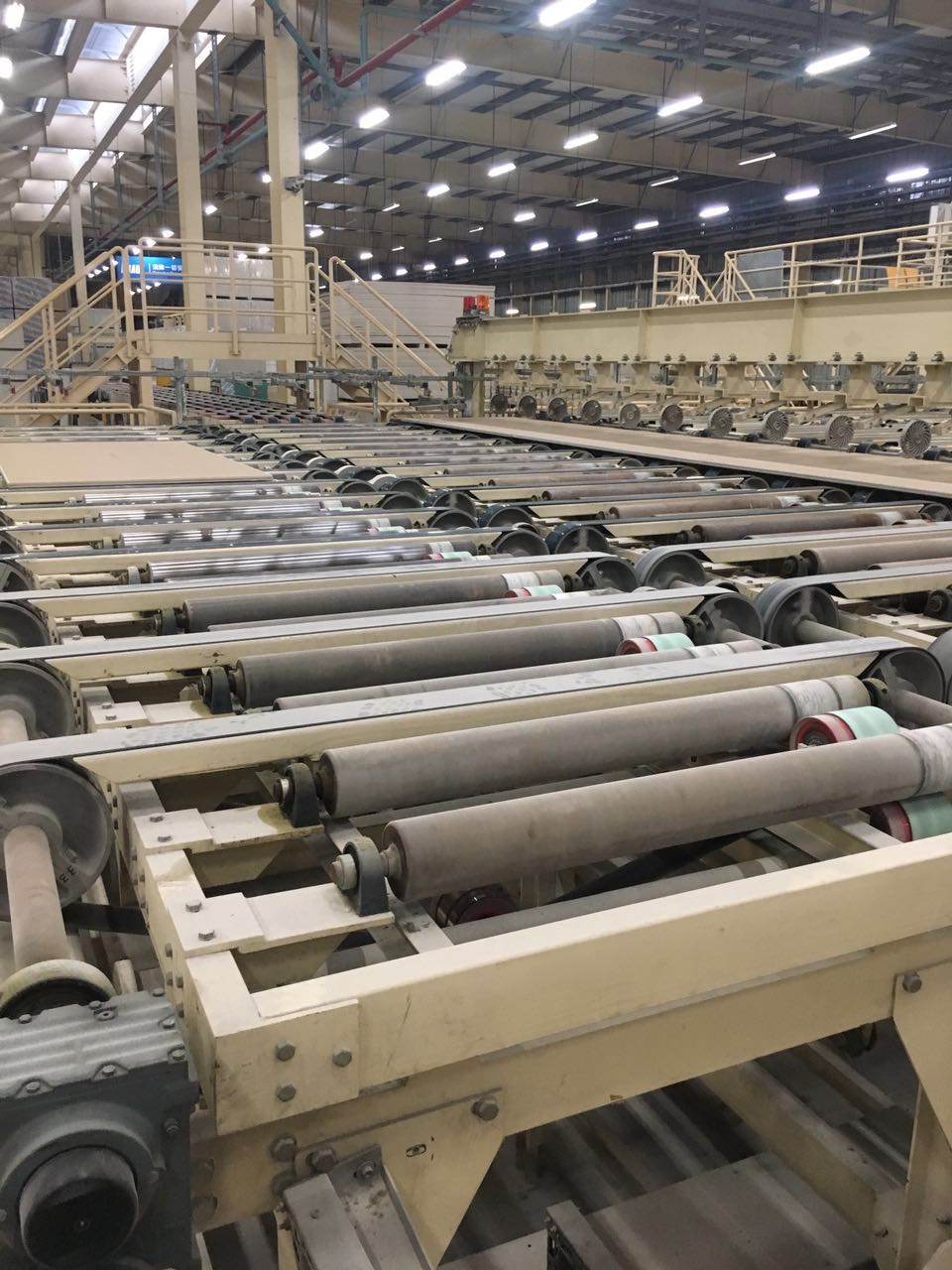
Due to business expansion, a large gypsum board manufacturer in Jiaxing planned to upgrade and renovate its existing production line, in which the splicing and selection of gypsum board roller conveyor belts was a key link. The enterprise's original conveyor belts suffered from varying degrees of wear, mistracking and other problems, seriously affecting production efficiency and product quality. This upgrade required splicing a large number of new conveyor belts, which had to meet the specific conditions of wear resistance, no mistracking and low productivity, and also had to adapt to the small tensioner of the customer's equipment.
Large splicing demand: The production line is large in scale, and a large number of conveyor belts needed to be spliced, with the requirement that they convey in sets, to ensure the continuity and stability of the entire production process.
Wear resistance requirement: During conveying, gypsum boards rub against the conveyor belts. To guarantee the service life of the belts and reduce replacement frequency, the belts were required to have outstanding wear resistance.
Anti-mistracking requirement: Belt mistracking causes the position of gypsum boards to shift during conveying, affecting subsequent processing operations and possibly even causing equipment damage; it was therefore essential to ensure that the belts do not mistrack during operation.
Low productivity requirement: The customer's production process dictated that the productivity of the conveyor belts needed to be controlled within a relatively small range, to meet the specific production pace.
Tensioner adaptation requirement: The tensioner of the customer's equipment is small, and the newly selected conveyor belts needed to match this tensioner well to ensure the tensioning effect.
Market research: The project team conducted extensive research on various conveyor belts on the market, collecting information on belts of different brands, materials and specifications, focusing on key indicators such as wear resistance, anti-mistracking capability and tension characteristics.
Preliminary screening: Based on the customer's requirements, several types of conveyor belt that might be suitable were screened out, including polyester canvas conveyor belts, nylon conveyor belts and PVC conveyor belts. Performance tests and analyses were carried out on these belts to evaluate their performance in wear resistance, anti-mistracking and other aspects.
Comprehensive evaluation: Taking into account the small tensioner of the customer's equipment, tension characteristic tests were further carried out on the screened belts to evaluate their adaptability to a small tensioner. After comprehensive evaluation, a special-material polyester rubber power transmission belt was finally selected. This conveyor belt has high strength and wear resistance, and its tension characteristics can match the customer's small tensioner; while ensuring the transmission effect, it can effectively reduce the required tensioning force.
Professional team formation: A professional conveyor belt splicing team with rich experience was invited; the team members possess professional technical knowledge and operating skills and are familiar with the splicing processes of various conveyor belts.
Site survey: Before construction, the splicing team carried out a detailed survey of the site, learning about the belts' installation environment, roller layout, tensioner positions and other conditions, to provide a basis for formulating the splicing plan.
Plan design: Based on the site survey results and the characteristics of the conveyor belt, a scientific and reasonable splicing plan was designed. A hot-melt splicing process was adopted, which can ensure the strength and stability of the belt splice and reduce the risk of wear and mistracking at the splice. At the same time, parameters such as temperature, pressure and time during splicing were precisely controlled to guarantee splicing quality.
Preparation: Before splicing construction, the conveyor belts were cleaned and pretreated to ensure the splice surfaces were flat and clean. At the same time, the required tools and materials were prepared, such as a hot press, adhesive and heating plates, and the equipment was adjusted and checked to ensure it operated normally.
On-site splicing: In accordance with the predetermined splicing plan, the professional team carried out the construction in a tense and orderly manner. During splicing, operations were performed strictly in accordance with the process requirements to ensure the quality of every splice. At the same time, the belt tension was monitored and adjusted in real time to guarantee the smoothness of the belts during operation.
Quality inspection: After splicing was completed, a comprehensive quality inspection was carried out on every conveyor belt, including strength tests of the splices and mistracking tests. Problems found were rectified in good time to ensure that all conveyor belts met the customer's usage requirements.
Successful completion of the splicing task: The project team completed the splicing work for a large number of conveyor belts within the stipulated time, and all belts achieved conveying in sets, ensuring the normal operation of the production line.
Meeting customer requirements: The selected conveyor belts have outstanding wear resistance, effectively reducing wear in actual operation and extending service life. At the same time, no mistracking occurred during belt operation, ensuring the conveying accuracy and stability of the gypsum boards. In addition, the productivity of the belts met the customer's requirements and matched the production process.
Adapting to the tensioner: Verified through actual operation, the selected conveyor belts matched the small tensioner of the customer's equipment well, with a stable tensioning effect, ensuring the normal tension of the belts.
The customer was very satisfied with the completion of the project, holding that the project team displayed a high degree of professionalism and responsibility in the conveyor belt selection and splicing process. The new conveyor belts solved the problems of the original belts, improved production efficiency and product quality, and provided strong support for the enterprise's development. This cooperation also laid a solid foundation for further cooperation between the two parties.
 Technical Consultation
 Sales Consultation