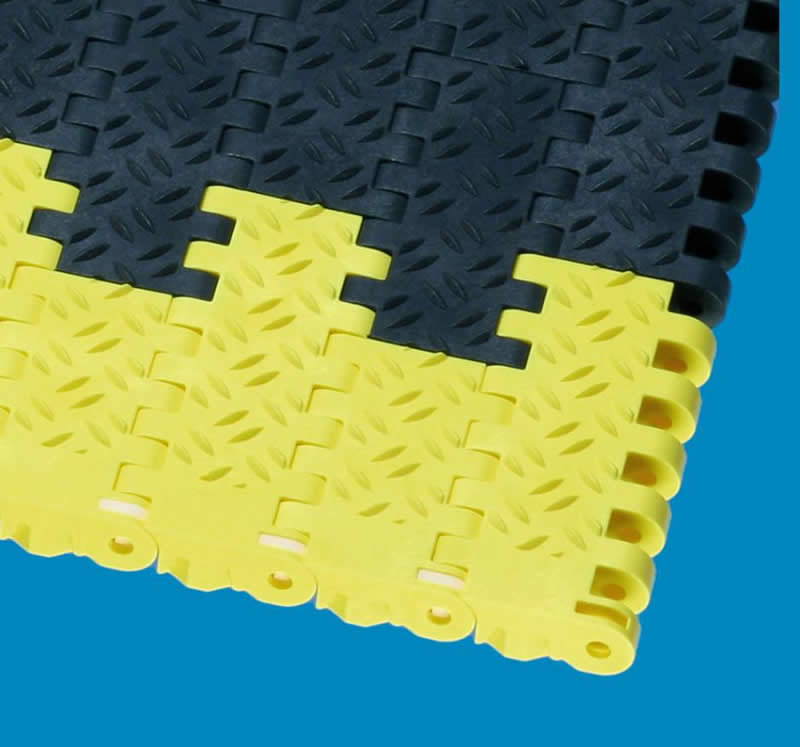
The structural design of conventional plastic modular belts is not suitable for all fields of application. In the following situations, the Monty Chain plate belt can provide a more suitable solution: the material is corrosion-resistant, durable and inherently safe (all standard materials used comply with FDA standards). Cleaning a plastic modular belt as prescribed is simple and easy to carry out.
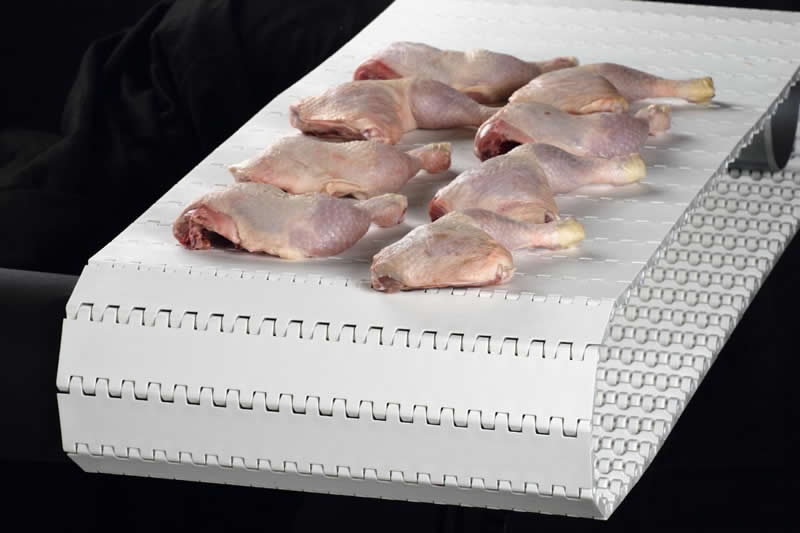
Every plastic modular belt is a specialized design. The Monty Chain plate belt system comprises ten different series, whose functional designs suit different conveying and processing operations.
Embedded hinge pins connect the individual modules, giving them flexibility and continuity.
This means: Variable width and length
—
— Simple maintenance
—
Low stock levels Existing machinery can easily be converted to Monty Chain plate belt plastic modular belts. In addition to the standard colors, any color can be provided on request.
High-quality materials By using different materials, the different module types have more specialized properties.
Thanks to this variability, Monty Chain plate belt plastic modular belts can meet all practical requirements: conveying, positioning, washing, drying, freezing… Plastic materials (properties) PA (polyamide) Good wear resistance in dry applications
Good fatigue resistance
Temperature range -40 to +120 °C (-40 to 248 °F)
— Excellent high-temperature resistance, short-term temperature resistance up to 135 °C (275 °F) (surface contact temperature)
—
— FDA/EU certified, can be in direct contact with food Flame retardancy complies with UL94-V2 PA-HT (high-temperature-resistant polyamide) Material reinforced with glass fiber
—
—
Extremely low water absorption in humid environments Very robust and durable
— Temperature range -30 to +155 °C (-22 to 311 °F)
—
— Excellent high-temperature resistance, short-term temperature resistance up to 180 °C (356 °F)
— FDA/EU certified, can be in direct contact with food (blue only) PBT (polybutylene terephthalate) Good wear resistance
—
Can be used in abrasive environments Good strength and rigidity
— Temperature range -40 to +120 °C (-40 to 248 °F)
—
— Not recommended for use in hot water > 50 °C (122 °F) FDA/EU certified, can be in direct contact with food PE (polyethylene) Excellent acid and alkali resistance
—
— Low surface adhesion gives it excellent release properties
Good friction properties and wear resistance
— Very impact-resistant Low specific gravity
— Limited load-bearing capacity Temperature range -70 to +65 °C (94 °F to 149 °F)
—
—
—
— FDA/EU certified, can be in direct contact with food PE-MD (metal-detectable polyethylene) Modified polyethylene
— This material is easy to detect in metal detectors
FDA/EU certified, can be in direct contact with food PLX (wear- and impact-improved polymer) Good wear resistance Can be used in abrasive environments
—
—
Good fatigue resistance Suitable for dry, wet and immersed use (does not absorb moisture)
—
— High impact resistance
— Good acid and alkali resistance Temperature range -45 to +120 °C (-49 to 248 °F)
—
—
— Short-term temperature resistance up to 150 °C (302 °F) FDA/EU certified, can be in direct contact with food POM (polyoxymethylene/polyacetal) Excellent dimensional stability
—
—
Very robust and durable Excellent resistance to organic solvents
—
— Lower coefficient of friction
— Very durable material Hard, cut-resistant surface
—
—
— Temperature range -45 to +90 °C (-49 to 194 °F) FDA/EU certified, can be in direct contact with food POM-CR (cut-resistant polyoxymethylene)
—
Modified POM Impact-resistant, excellent cut resistance
—
— Low risk of a ridged surface
— Greatly reduces the risk of material delamination
—
— FDA/EU certified, can be in direct contact with food POM-HW (high-wear-resistant polyoxymethylene) Modified POM
— High wear resistance POM-HC (highly conductive polyoxymethylene) Modified POM
—
— Highly conductive material Surface resistivity < 10⁶ Ω (according to ISO 21178)
— Excellent friction properties and wear resistance POM-MD (metal-detectable polyoxymethylene) Modified POM
—
— This material is easy to detect in metal detectors
FDA/EU certified, can be in direct contact with food PP (polypropylene) Standard material for general conveying applications
—
—
—
— High strength, good rigidity
—
— Good dynamic capability Excellent resistance to acids, alkalis, salts and alcohols
— Low specific gravity No risk of stress cracking
Temperature range +5 to +100 °C (41 to 212 °F)
— FDA/EU certified, can be in direct contact with food PP-MD (metal-detectable polypropylene) Modified PP
—
This material is easy to detect in metal detectors
— FDA/EU certified, can be in direct contact with food PXX-HC (PXX flame-retardant conductive material) Flame retardancy,
— Complies with DIN EN 13501-1 Cfl-s1 and DIN 4102 (B1) Surface resistivity 10⁶ Ω (according to ISO 27178)
—
— Especially suitable for the automotive industry Temperature range +5 to +100 °C (41 to 212 °F) TPC1 (thermoplastic copolyester) Sprocket and impact-resistant mesh belt material
—
—
— Resistant to abrasion
— Wear-resistant Excellent impact resistance
—
— Suitable for light or medium loads
— Low brittleness, high toughness Hardness 60 Shore D Temperature range -25 to +80 °C (-13 to 176 °F)
— FDA/EU certified, can be in direct contact with food

 Technical Consultation
 Sales Consultation